What AI can read about UK businesses
Scanned August–September 2026 · updated 3 October 2026
We scanned 82 UK business websites across four industries to measure what an AI assistant can actually read about them. These are the results, by vertical. No business is named.
| Vertical | n | Median | Range |
|---|---|---|---|
| Wedding venues | 21 | 64.5 | 48.6–82.7 |
| Estate agents | 10 | 62.9 | 53.2–76.4 |
| Solicitors | 9 | 68.2 | 33.2–90.9 |
| Hotels | 30 | 55.5 | 10.0–71.8 |
True in every vertical
Three findings held across all 82 businesses we scanned, regardless of industry:
| Check | Score | What it means |
|---|---|---|
| Agentic commerce endpoints | 0.00 | Not one business of 82 exposes an ACP or AP2 surface. An assistant cannot transact with any of them directly. |
| llms.txt guidance file | ~0.15 | Almost nobody publishes one. It is free to add and takes minutes. |
| Structured data (schema.org) | 0.25–0.32 | The single biggest scoring gap in every vertical. Without it an assistant has to infer what the business even is from prose. |
What this measures, in fourteen seconds
Where does your site sit?
The same audit, run on your own domain. One field, about twenty seconds, no account and no card.
Run the free check →How this was measured
Each site was scanned by an automated audit that scores nine weighted checks: crawler access, structured data, whether content survives without JavaScript, machine-readable pricing, bot protection, terms and security, an llms.txt guidance file, sitemap discoverability, and agentic commerce endpoints. The score is out of 100.
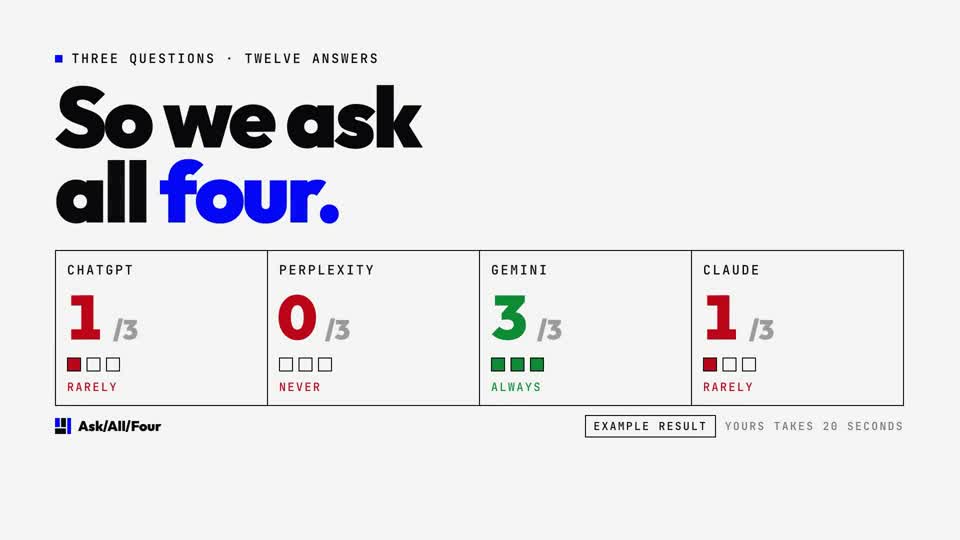
This measures what a machine can read on the public website. It is a separate question from whether an assistant actually names the business when asked — that is measured by putting real questions to ChatGPT, Perplexity, Gemini and Claude, and the two do not always agree.
n = 82 · scanned August–September 2026 · no business named