▪ asking · 0%
Asking four assistants three questions about you.
AI assistants disagree about your business.
which ones name you?
Your customers are asking all four for somewhere to stay, someone to hire, somewhere to book. We ask three of the questions they would, then show who gets recommended instead of you.
One field. We work out the rest.
Four real businesses, four trades, checked in the last week. Sometimes every assistant names you and the answer is simply good news. Sometimes two of them have never mentioned you once. Whichever assistant your tool happens to check decides which of those you are told.
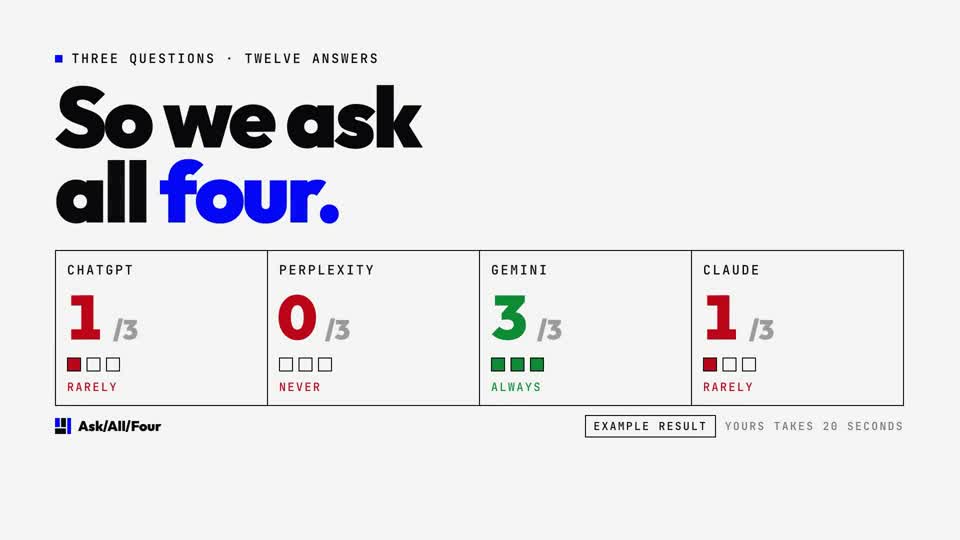
One business in four gets opposite answers.
We asked twelve real UK businesses the same question across four assistants on the same day. 741 queries in total. Each assistant agreed with itself almost every time, and disagreed with the others constantly.
Most tools check one assistant, usually ChatGPT, because it is cheapest to query. On these numbers, which one they picked decides whether you are told you are winning or invisible.
Most tools check one assistant
and call it a score.
There are two dozen AI visibility tools now. Nearly all of them ask a single engine, feed it your brand name, and hand back one number. Every step of that hides the thing you actually need to know.
The cheapest plans on the market track ChatGPT and nothing else, then charge per extra engine. On our numbers that is the one decision that changes the answer.
Four engines, four sources, sixty seconds.
Your website
We work out what you do and where from your domain, then draft three questions your buyers actually ask. Edit any of them before we go.
All four engines
ChatGPT, Perplexity, Gemini and Claude, each asked all three questions, the way a customer asks, not by feeding them your brand name.
Who gets named
Which assistants name you, and the businesses named instead of you.
Where AI looks first
The profiles and directories an assistant reads before it ever reaches your website.
What the check actually does.
The things people ask first.
Is it actually free?
Yes, and there is no card. We ask four assistants three questions each about your business and show you what they said. We pay for those twelve queries.
Why do you want my email?
The headline is free to read. The full breakdown needs an email: which assistant said what, who was recommended instead, and which directories list you. That is the only thing we ask for and we do not sell it.
How do I know this is not made up?
Whether you were named is decided by plain text matching on the name you gave us. No AI judges that part, so the same answers always give the same result. Every directory we list comes with a link you can click.
Why four engines and not one?
Because they disagree. We tested twelve real UK businesses across four assistants on one day: one in four got flatly opposite answers, named every single time by one, never once by another.
Why three questions and not one?
Because buyers do not all ask the same thing, and you are rarely equally visible for all of it. Asking the same question twice tells you almost nothing new: two runs of one engine disagree only 4.7% of the time. Asking a different question routinely changes who gets named.
What if it changes tomorrow?
It might, and that is the point. These answers move on their own as models update. We can re-run the check weekly and tell you when something actually changes.